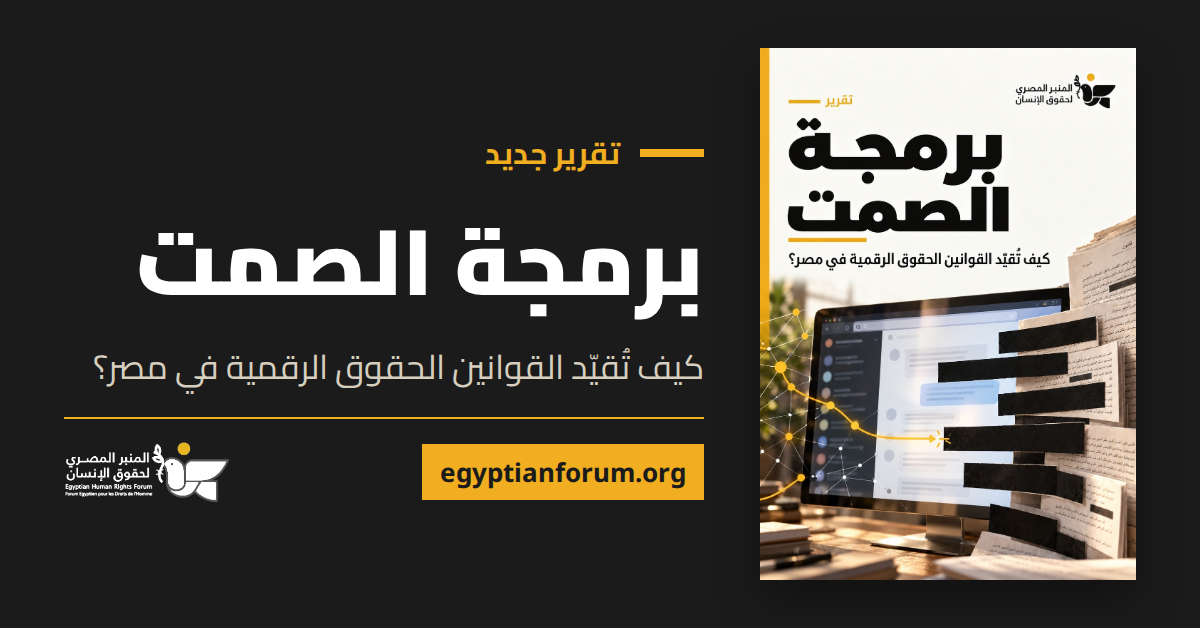
Paris, 5 November 2026. Egypt’s Constitution protects free expression, a free press, access to information and private correspondence. But a decade of legislation has quietly reversed that order, according to Coding Silence: How Law Restricts Digital Rights in Egypt, a new report published today by the Egyptian Human Rights Forum (EHRF) in English and Arabic.
The report analyses the main laws governing online life adopted since 2003 and finds that restrictions on online life are not incidental abuses but are written into the law itself, through vague standards such as “national security” and “family values” that allow almost any content to be blocked, licensed or prosecuted.
Key findings
- Blocking without a decision. Mass website blocking began on 24 May 2017 with no announced decision or legal basis. Blocking now runs through criminal, regulatory and structural legal routes, including an urgent track under Article 7 of the Anti-Cybercrime Law that blocks first and reviews later.
- A licence to exist. News websites must pay EGP 50,000 for a five-year licence, and personal accounts with more than 5,000 followers can be suspended or blocked by the media regulator.
- Surveillance of everyone. Service providers must retain every user’s identity and traffic data for 180 days, regardless of any suspicion, while the data protection law exempts security bodies.
- Protection treated as a threat. Using encryption requires approval from the telecoms regulator, the Armed Forces and national security agencies, and owning a drone without a permit carries one to seven years in prison.
The tools in use
The report’s findings are playing out now. On 27 October 2026, a Cairo court fined Mada Masr’s editor-in-chief EGP 3 million, the maximum penalty, and ordered the independent news site closed for operating without a licence it had applied for in 2018 and 2020. Since late September, the six journalists of the fact-checking platform Matsadaash have been held in pretrial detention on charges including belonging to a terrorist organisation, which the platform rejects.
“Egypt does not need to abolish free expression to silence it. It only needs laws vague enough to make every post, every website and every encrypted message a potential crime,” said.Yosra Elgendi, Secretary general of Egyptian Human Rights Forum (EHRF) . “Real security in the digital space comes from clear and predictable rules, not from widening the state’s power to intervene.”
What must change
The report sets out nine recommendations to the Egyptian authorities:
- Narrow the exceptions. Tie every provision allowing blocking, suspension or disruption of content to specific standards, with precise legal definitions of “national security”, “imminent danger” and “family values”, and ensure no administrative decision seriously affects rights without a clear legal basis and fast judicial oversight.
- Procedural safeguards for every block. Require notice, written reasons and an immediate appeal before an independent judge within short deadlines; suspend a block by default on appeal where it would cause serious harm; and publish regular data on the number, scope and legal basis of blocking orders.
- End licensing as a condition of existence. Replace costly prior licensing of news websites with a simple notification system and proportionate fees, and treat an unanswered application as approved after a set period, or at least require a reasoned decision open to rapid appeal.
- Limit data retention and access. Reduce the period and scope of mandatory retention, allow access only by a reasoned judicial order based on necessity and proportionality, document every request for independent review, and impose strict security rules on data holders.
- Strengthen data protection. Narrow the broad exceptions for security bodies, set objective criteria for their requests, guarantee the independence of the enforcement body, and give individuals fast, practical rights of access, rectification, erasure and objection.
- Rely less on criminal law. Reconsider vague “false news” offences, reduce imprisonment in publication and expression cases, and develop balanced civil remedies for insult and defamation.
- Protect encryption and anonymity. Treat encryption as a legitimate means of protecting communications, privacy and journalistic work, not a capability that requires prior permission, and keep criminalisation focused on specific harmful acts rather than protective tools.
- Regulate dual-use technology by risk. Replace blanket bans on telecoms equipment and drones with risk-based rules that distinguish civilian and research uses, publish clear lists and standards, graduate penalties so prison is a last resort, and guarantee a right to appeal refusals.
- Fix the Criminal Procedure Law before October 2027. Adopt implementing rules that keep digital surveillance and electronic tracking to the minimum necessary, for a set period and under genuine judicial supervision, and guarantee confidentiality, defence rights and the integrity of records in remote investigations and trials.
EHRF also calls on the European Union to assess Egypt’s digital laws under the human rights precondition of its €4 billion macro-financial assistance before the final tranche is paid.
Read the full report: [REPORT LINK] (English) ·
About the Egyptian Human Rights Forum
The Egyptian Human Rights Forum (EHRF) is an independent Egyptian human rights organisation founded in March 2018. EHRF works to promote the implementation of international human rights law in Egypt, advocate for a rights-based approach to democracy and the rule of law, and bring together political, civil and human rights actors inside Egypt and in the diaspora around shared reform proposals.
Media contact: Media team, [email protected]. Interviews available in English, Arabic