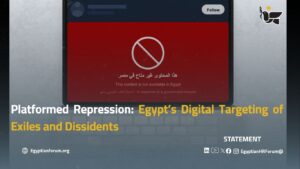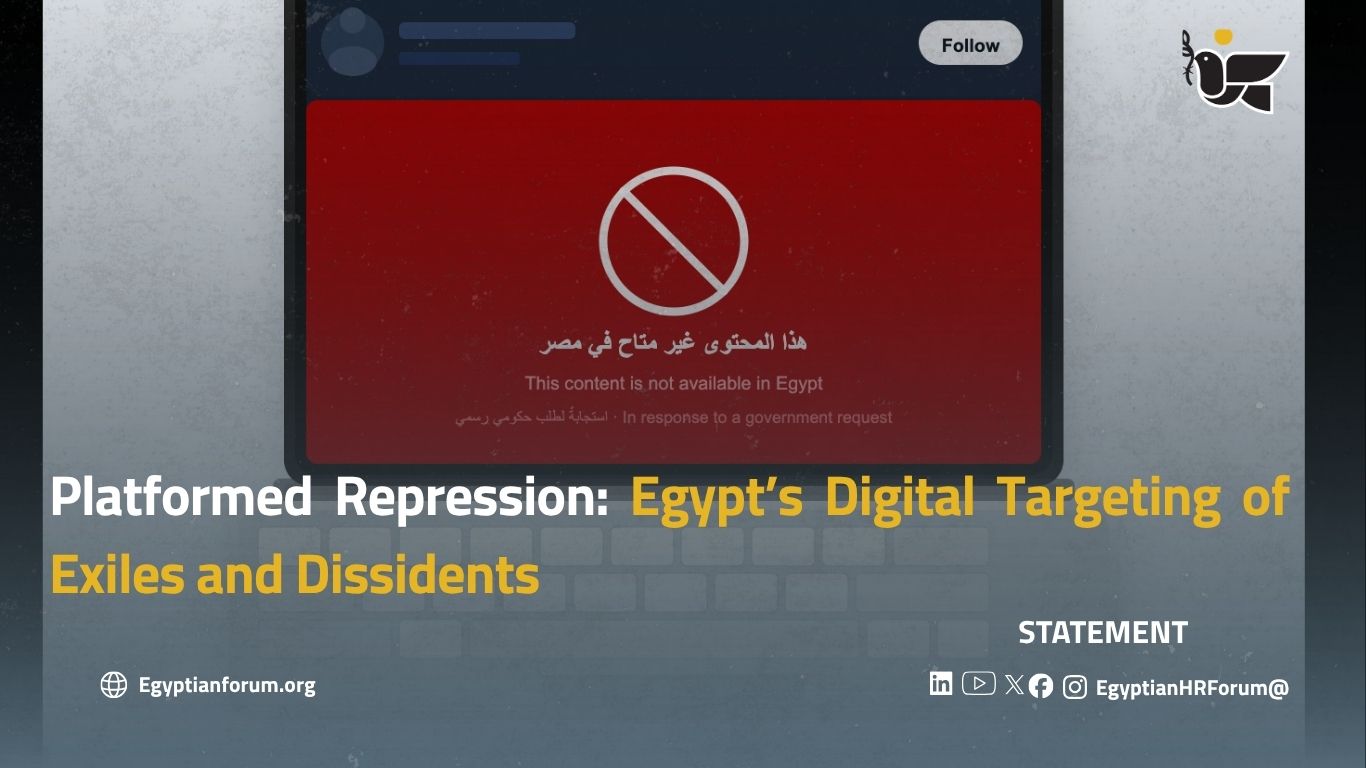
The Egyptian Human Rights Forum (EHRF) condemns Egyptian Public Prosecution's formal order of May 21, 2026, directing the blocking of social media accounts belonging to 12 individuals — including prominent exiled journalists and opposition figures — across Facebook, Instagram, X (Twitter), TikTok, and Telegram. This order is an act of transnational digital repression: the use of state legal mechanisms and platform infrastructure to silence voices the Egyptian government cannot otherwise reach.
The Egyptian Public Prosecution issued a formal decision compelling technical and security authorities to block the accounts of 12 individuals on all social media platforms within Egyptian territory. Enforcement operates on two tracks:
Track 1 — Network infrastructure: The Prosecution directed the National Telecommunications Regulatory Authority (NTRA) to implement blocking via Egyptian internet service providers, making accounts unreachable at infrastructure level regardless of platform cooperation.
Track 2 — Direct platform demands: Simultaneously, formal legal requests were dispatched directly to Meta, X, TikTok, and Telegram, invoking international law enforcement frameworks and agreements on geo-restriction of “violence-inciting content” — demanding active platform compliance.
The individuals named include prominent dissidents public figures among them Amr waked, Abdullah Al-Sharif, Mohamed Nasser, Osama Gaweesh, Haitham Abu Khalil, Sami Kamal El-Din, Khaled Al-Seerti, Sherif Othman, Hisham Sabry and others.
The majority are journalists and political dissidents living outside Egypt — people who left because they could not speak freely within it. Several carry prior convictions issued in absentia in proceedings human rights organizations have documented as politically motivated. The stated charges — “incitement to hatred,” “spreading false news threatening national security,” “defaming state institutions” — are the identical formulations Egypt has used for years to prosecute journalism and political criticism.
This order is also part of a broader campaign by Egypt's Supreme Council for Media Regulation targeting digital content, which has simultaneously resulted in additional account blockings and referrals for investigation on charges of publishing content “violating societal values.”
Egyptian authorities cannot prosecute journalists it cannot reach. This order is the alternative: using global platform infrastructure as the long arm of state censorship. The NTRA-to-ISP mechanism ensures Egyptian audiences are cut off regardless of platform cooperation; the direct legal demands to Meta, X, TikTok, and Telegram seek to make the platforms active instruments of that silencing.
Critically, Egyptian authorities are framing these demands as compliance with international law enforcement frameworks on violence-inciting content — borrowing the language of legitimate platform governance to launder what is, in substance, political censorship. Platforms that accept this framing will not merely execute one order. They will validate a doctrine that every authoritarian government seeking to silence exiled critics can now invoke.
This order is an example for authoritarian regimes collaboration. Since April 30, 2026, Meta has geo-blocked the Facebook and Instagram accounts of Gulf-focused NGOs and human rights defenders — including ALQST for Human Rights, Democratic Diwan, Abdullah Alaoudh, and Yahya Assiri — at the formal request of Saudi and UAE authorities, citing cybercrime laws. Meta's own content restriction reports document over 100 accounts restricted since March 2026. The restricted content explicitly includes “reporting on regional geopolitical conflicts” — coverage of the US and Israeli strikes on Iran.
Egypt's order follows the same legal architecture as the Saudi and UAE requests. The Saudi and UAE governments now have documented evidence that Meta complies. Egypt is making the same ask. The precedent Meta set is the foundation on which this order rests.
EHRF calls on Meta, X (Twitter), TikTok, and Telegram to:
- Refuse to comply with the Egyptian Public Prosecution's May 21 blocking order and confirm publicly that no action has been or will be taken against any of the 12 named accounts.
- Disclose immediately whether any request — formal or informal — was received from Egyptian authorities or the NTRA regarding these accounts, and what action, if any, was taken.
- Restore any accounts or content already restricted in connection with this order.
- Reject the framing that charges of “false news threatening national security” or “incitement” by Egyptian authorities meet any international standard for content restriction, given the extensively documented misuse of these charges against journalists and dissidents.
- Commit publicly to refusing government requests that target exiled journalists and opposition figures for the exercise of protected political speech, regardless of the legal instrument used.
We call on Meta specifically, regarding Saudi Arabia and the UAE, to:
- Immediately restore all accounts geo-blocked at the request of Saudi and UAE authorities since March 2026.
- Publish the full legal requests received from those governments alongside the human rights assessments Meta claims to have conducted — including who conducted them and what standards were applied.
- Explain what role, if any, Meta's regional Gulf offices played in processing these requests.
We call on the UN Special Rapporteur on Freedom of Expression and the UN Special Rapporteur on Human Rights Defenders to:
- Issue urgent communications to the Government of Egypt identifying this order as incompatible with Egypt's obligations under Articles 19 and 22 of the ICCPR.
- Engage Meta, X, TikTok, and Telegram under the UN Guiding Principles on Business and Human Rights regarding their obligations to refuse compliance with censorship requests that do not meet international human rights standards.
- Formally examine Egypt's invocation of “international law enforcement mechanisms” as a doctrine for laundering transnational repression through platform compliance systems.