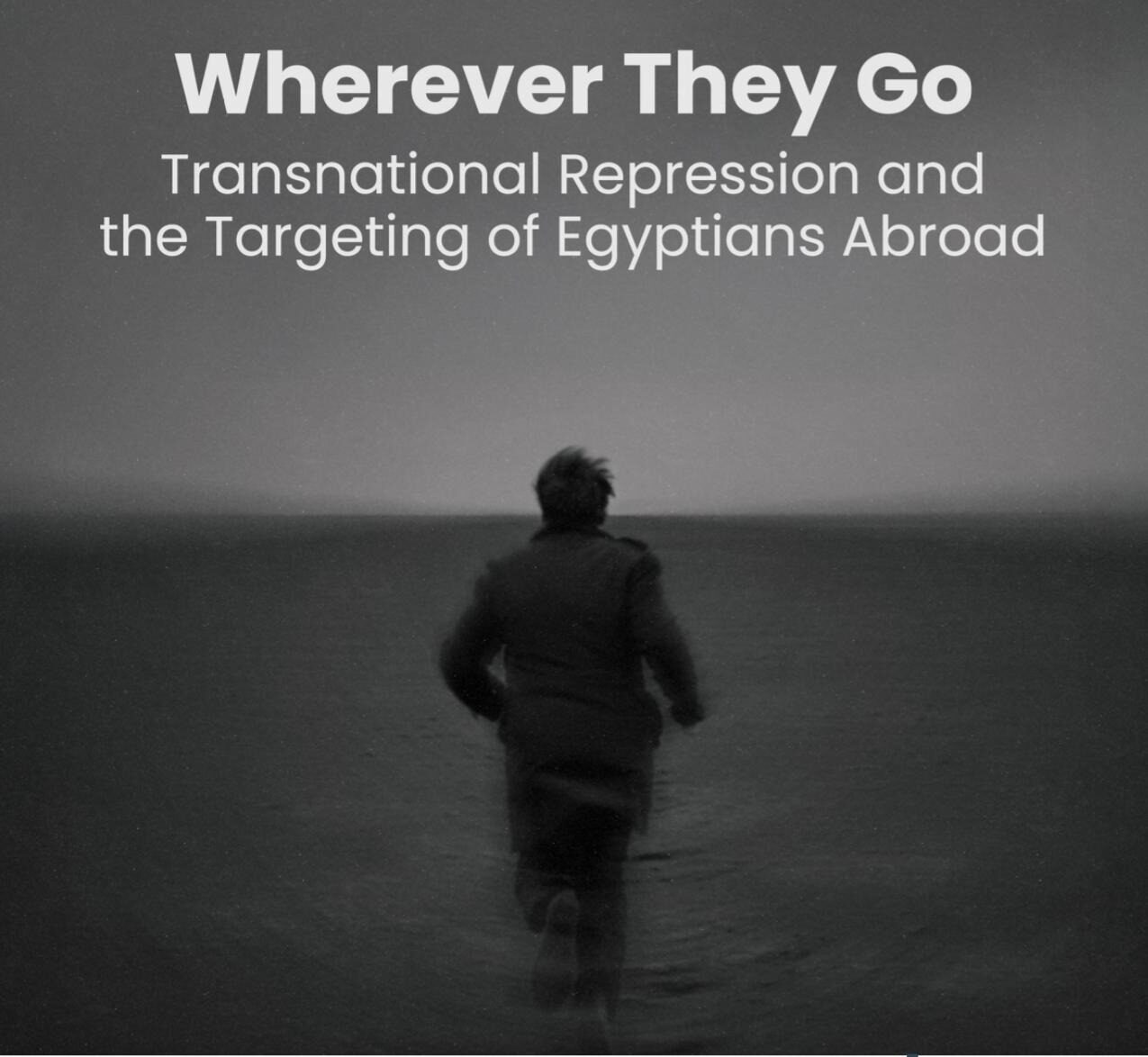
The Egyptian Human Rights Forum (EHRF) launched today its second annual report, “Wherever They Go: Transnational Repression and the Targeting of Egyptians Abroad,” during a press conference held at the European Press Club in Brussels. The event featured the participation of Member of the European Parliament Chloé Ridel from the Progressive Alliance of Socialists and Democrats, EuroMed Rights Vice President Moataz El Fegiery, President of the International Federation for Human Rights (FIDH) Alexis Deswaef, and EHRF Executive Director Samar Elhussieny.
The report is the result of more than a year of research and documentation. It is based on in-depth interviews with activists, journalists, and human rights defenders across numerous countries and geographic locations, in addition to qualitative surveys, data analysis, and the development of the first specialized database documenting patterns of transnational repression practiced by the Egyptian authorities against their citizens abroad.
The report unpacks the concept of “illusory protection in exile,” revealing how exile—supposed to be a space for safety and rebuilding one’s life—has instead become a permanent condition of tension, anticipation, and pursuit. From countries expelling exiles for narrow political calculations, to international airports turning into points of detention and threats of deportation; from targeting families inside Egypt as a means of pressure, to digital and technological surveillance, smear campaigns, and even denying newborn children the right to identity and official documentation. The report also documents cases of threats and harassment in Europe, North America, and the Middle East, portraying a reality in which safe spaces shrink despite the vastness of the map, and every word or movement becomes a carefully calculated risk.
The report adopts a mixed quantitative and qualitative methodology. The survey included 34 Egyptian participants abroad, of whom around two-thirds (approximately 66%) reported being denied passports, official documents, or basic consular services, leaving many in precarious legal situations in their countries of residence. Approximately 72% indicated that family members inside Egypt had been subjected to security summonses, harassment, or travel bans due to their activities abroad. Nearly half reported facing direct threats or in-absentia prosecutions, while around one quarter experienced digital harassment, smear campaigns, or attempted forced deportation.
In parallel with the survey, the report documents 84 individual cases through a cumulative database spanning at least 17 countries and geographic locations, enabling the identification of recurring patterns including arbitrary denial of consular documents, revocation of nationality, misuse of international security cooperation mechanisms, digital surveillance, and proxy punishment through the targeting of families. Database indicators show that approximately 82% of recorded victims are male compared to 18% female, and that the overwhelming majority are active in political, human rights, or media work.
Read full report
The data further reveal a notable geographic concentration of cases in Turkey as the most frequently recorded country in the database, followed by Egypt, the United Kingdom, and a number of European and Gulf states, reflecting patterns linked to political migration routes and hubs of media and human rights activity. Indicators also show that a significant proportion of cases involve denial of consular services or identity documents, followed by in-absentia prosecutions and security threats, then digital harassment and media defamation—highlighting the intersection of legal, administrative, and technological tools within a cross-border repression system. The database also demonstrates that targeting families inside Egypt is a recurring element in a large number of documented cases, rather than isolated incidents.
Moataz El Fegiery, Vice-President of EuroMed Rights and President of the Egyptian Human Rights Forum, stated “The systematic resort to repressing Egyptians abroad is not only aimed at intimidating activists and deterring them from engaging in political or human rights work in exile; it also appears to constitute a deliberate policy to deprive political and human rights actors in exile of any possibility of a safe and unconditional return to their homeland.”
Alexis Deswaef, president of the FIDH – International Federation for Human Rights “Egypt is one of the most active countries in terms of transnational repression, with arresting relatives, blocking exiled media outlets, targeting individuals with spyware, and refusing consular services and identity documents, including for children. These practices include the use of diplomatic missions to repress peaceful protesters and the harassment of families remaining in Egypt. When transnational repression occurs, it directly violates fundamental human rights. States have an obligation to guarantee the rights of all persons within their territory and to provide effective remedies against these violations by Egypt.”
Samar Elhussieny, Executive Director of the Egyptian Human Rights Forum, commented “Repression does not stop at borders. This report and database provide clear evidence of the targeting of Egyptians abroad, and we call for more serious protection and accountability policies. We also stress that children, women, and the families of defenders are not collateral damage, but real victims who deserve protection and redress, as transnational repression threatens an entire generation with the loss of identity.”
This publication represents the second comprehensive annual report issued by the Egyptian Human Rights Forum on transnational repression. Previous and current editions have become reference sources in analyzing this phenomenon, having been cited in reports and opinions issued by UN human rights mechanisms, as well as in studies by the European Parliament and draft resolutions and official discussions addressing ways to counter transnational repression and protect human rights defenders in exile.
The report highlights the profound psychological and social impact of these practices. Testimonies and data point to widespread chronic anxiety, insomnia, and a constant fear of detention or deportation—even in countries presumed to provide legal protection. With around 72% of participants reporting pressure or security summonses against their families in Egypt, feelings of guilt and helplessness have emerged among many exiles, alongside growing self-censorship and avoidance of public appearances or participation in events. The exposure of nearly one quarter of participants to digital harassment has led to declining trust in online communication and shrinking social support networks. The impact extends to children in cases involving denial of documents or delayed birth registration, affecting their right to education, healthcare, and legal stability, and creating a condition of “unsafe exile,” where fear becomes a daily factor reshaping behavior, professional choices, and social relationships.
The report concludes with a set of practical recommendations addressed to relevant stakeholders:
First: To the Egyptian Government
- Establish an independent national body or mechanism with broad powers and diverse representation—including legal experts and independent civil society organizations inside and outside Egypt—to monitor and evaluate cases of transnational repression, particularly arbitrary denial of consular services and identity documents, provide policy advice, and conduct periodic, impartial risk assessments.
- End the misuse of judicial and security cooperation mechanisms, including Interpol and the Arab Interior Ministers Council, and ensure that activists are not pursued for political reasons.
- Terminate punitive consular practices that deprive citizens of passports or essential documents, and adopt a transparent, non-discriminatory policy for document renewal.
- Review terrorism designation lists and remove politically motivated listings, guaranteeing the right to appeal and independent judicial review.
- Cease targeting families and relatives of political opponents abroad, recognizing this as a form of collective punishment prohibited under international law.
- Engage civil society in shaping human rights policies and fully comply with the Convention Against Torture and the International Covenant on Civil and Political Rights.
- Ensure the immediate release of all individuals arbitrarily detained due to the activities of relatives abroad, and investigate retaliatory detention cases.
Second: To Host Countries and Government Authorities in Europe and North America
- Establish dedicated national contact points to receive reports of transnational repression and coordinate police and legal responses.
- Enhance training for police and prosecutors on the nature and risks of transnational repression, ensuring sensitive and prompt handling of complaints.
- Apply strict judicial scrutiny to all extradition requests and politically motivated security warrants, and rigorously uphold the principle of non-refoulement.
- Ensure that asylum and nationality procedures are not influenced by politically motivated warrants, lawsuits, or administrative obstacles originating from abusive states.
- Provide psychological and legal support to victims, and facilitate family reunification programs to mitigate the impact of family-based coercion.
- Activate targeted sanctions regimes, such as the U.S. Magnitsky Act or its European equivalents, against officials or entities involved in intimidation or threats beyond national borders.
Third: To the United Nations and International and Regional Intergovernmental Organizations
- Establish a dedicated UN mechanism or Special Rapporteur on transnational repression to collect data and coordinate international responses.
- Integrate this phenomenon into the Universal Periodic Review and into the reports of Special Rapporteurs on freedom of expression and human rights defenders.
- Develop a shared international database documenting cases and linking them to patterns of abusive state practices to facilitate accountability.
- Support legal protection programs and emergency relocation or shelter initiatives for human rights defenders and displaced persons, while ensuring sustainable funding for local human rights initiatives.
- Strengthen cooperation among regional human rights mechanisms—African, European, and Inter-American—to adopt common standards and coordinated strategies to combat transnational repression.