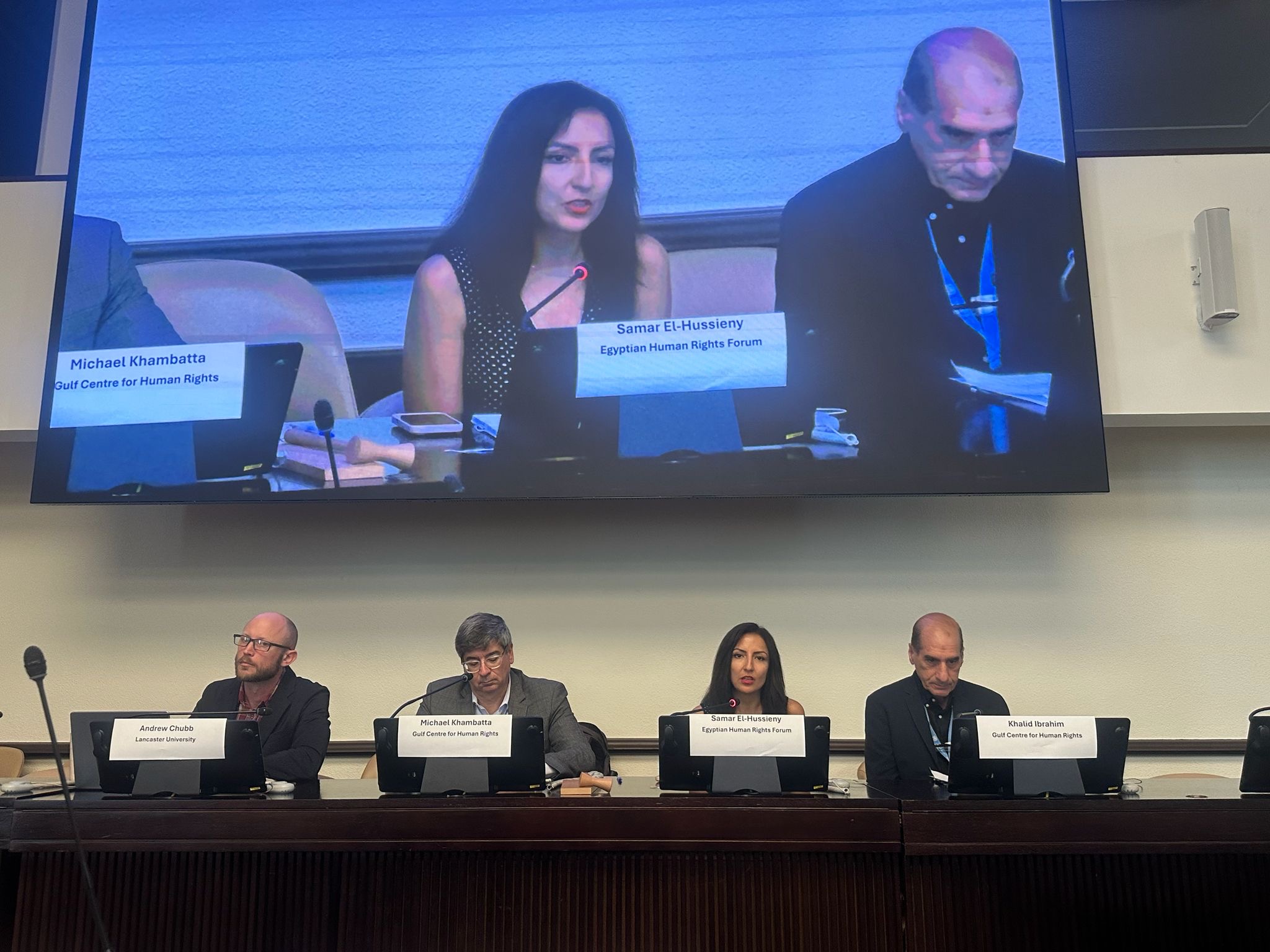
On 19 June 2026, the Egyptian Human Rights Forum Co-sponsored a side event in UNHRC entitled “Transnational Repression: Impact on MENA Human Rights Defenders,” examining the growing use of cross-border repression against human rights defenders, journalists, activists, and dissidents from the Middle East and North Africa.
The event was moderated by Michael Khambatta, Geneva Representative of the Gulf Centre for Human Rights, and featured contributions from Andrew Chubb of Lancaster University, Samar Elhussieny, Executive Director of EHRF, and Khalid Ibrahim, Executive Director of the Gulf Centre for Human Rights.
In her intervention, Elhussieny presented the findings of EHRF’s report “Wherever They Go: Transnational Repression and the Targeting of Egyptians Abroad,” together with updated findings from EHRF’s database documenting cases of Egyptian transnational repression. She explained that the database had recorded 119 verified cases, involving Egyptians targeted across at least 17 countries and locations, demonstrating that cross-border repression is not limited to isolated incidents but forms part of a systematic and evolving pattern.
She highlighted the main forms of repression documented through the report and database, including denial of passports, identity documents, birth certificates, and other consular services; prosecution in absentia; placement on terrorism lists; misuse of counter-terrorism legislation; threats and digital harassment; attempted forced return; and punishment by proxy against family members remaining in Egypt.
Elhussieny noted that consular and documentation-related violations were among the most frequently recorded patterns. Approximately two-thirds of those surveyed reported being denied or obstructed in accessing consular services, leaving many unable to travel, regularise their residence, access employment and essential services, register marriages or births, or exercise their right to return to Egypt.
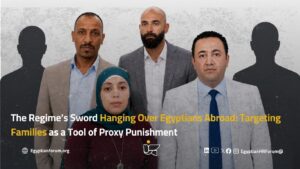
She also highlighted the scale of family-based reprisals, with around 72% of survey respondents reporting that relatives in Egypt had been subjected to some form of pressure or retaliation. These practices included arrest, interrogation, surveillance, threats, administrative harassment, and restrictions intended to pressure or silence defenders and activists abroad.
The intervention further addressed direct threats, in absentia proceedings, digital harassment, smear campaigns, and efforts to create conditions that expose individuals to detention, extradition, deportation, or forced return. Elhussieny stressed that the combined use of legal, administrative, digital, and family-based measures allows repression to cross borders even where no physical attack takes place in the host country.
EHRF emphasised that transnational repression should be treated as a cross-border human rights violation rather than solely as a national security, espionage, or foreign interference issue. Host states have an obligation to protect all individuals within their jurisdiction, regardless of whether the threat originates from a foreign government.
EHRF called on host states and international institutions to recognise the full range of transnational repression methods, establish accessible reporting and protection mechanisms, prevent the misuse of immigration, extradition, and international police cooperation systems, and improve coordination among law enforcement, migration, consular, and human rights bodies.
The event provided an important opportunity to present the evidence contained in “Wherever They Go” and EHRF’s growing case database within a wider regional discussion, and to advocate for stronger prevention, protection, and accountability measures for human rights defenders and other targeted individuals in exile.